Historical satellite analytics

Sixty years of Earth, measured.

Earthlytix turns satellite archives, from 1960s reconnaissance film to today's constellations, into georeferenced, analysis-ready maps. We measure how cities grew, forests fell and coastlines moved.

1966 2026
DOHA, QATAR · 25.28°N 51.52°E
1960s
Earliest imagery in our pipeline
60 yrs
Of change in one consistent series
Global
Any site with archive coverage
GIS-ready
GeoTIFF, vector layers & reports

Explore

Pick a city. Drag through time.

Each map pairs declassified film from the Cold War with today's high-resolution satellite imagery. Drag the handle to compare, then pan and zoom anywhere in the scene.

Historical imagery: U.S. Geological Survey declassified archive, shown at reduced resolution. Top-of-page preview: contains modified Copernicus Sentinel data 2026.

The archive

Decades of imagery, stitched into one record.

Most satellite analytics begin with recent imagery. We go back to the first satellite photographs of the Earth, then harmonise every era that followed so you can compare like with like.

1960s – 1980s

Reconnaissance film

Declassified Cold-War missions such as CORONA, GAMBIT and HEXAGON captured detailed imagery decades before commercial satellites existed.

1972 →

Landsat record

The longest continuous multispectral archive. It is the backbone for land-cover trends across half a century.

1999 →

Very-high resolution

Sub-metre commercial imagery for individual buildings, roads, plots and infrastructure.

2015 → today

Sentinel & constellations

Frequent revisits for current conditions, ongoing monitoring and near-real-time alerts.

How it works

From film canister to change map.

Historical imagery is hard to use. It is distorted, uncalibrated and unreferenced. Our pipeline handles that so you get clean answers, not raw pixels.

Source

We search every relevant archive for the best scenes covering your area and dates.

Rectify

Film is scanned, corrected for camera and terrain distortion, then co-registered to modern imagery.

Classify

Machine-learning models map land cover consistently across sensors and decades.

Quantify

Change is mapped and measured: hectares cleared, area built, shoreline moved, rate per decade.

Solutions

What we map, and what you get.

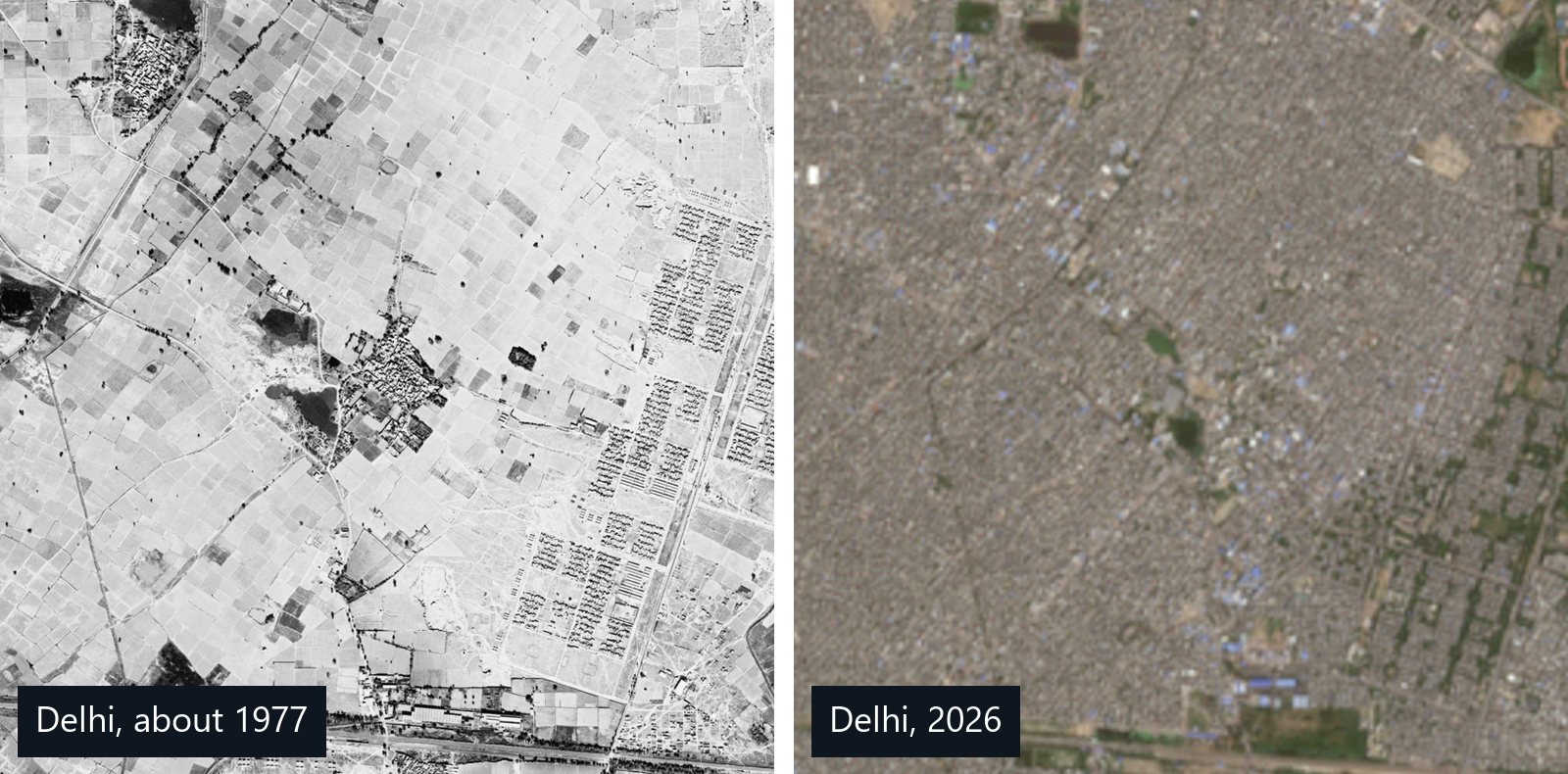
Delhi around 1977 with a village among fields, and the same area in 2026 fully built up
01 / URBAN EXPANSION

See how cities grew, decade by decade.

We map built-up extent for every available year, from 1960s film to today. Reports cover growth rates, the direction of sprawl and the farmland or green space each city absorbed.

  • Built-up footprints per epoch
  • Growth-rate statistics
  • Sprawl & density maps
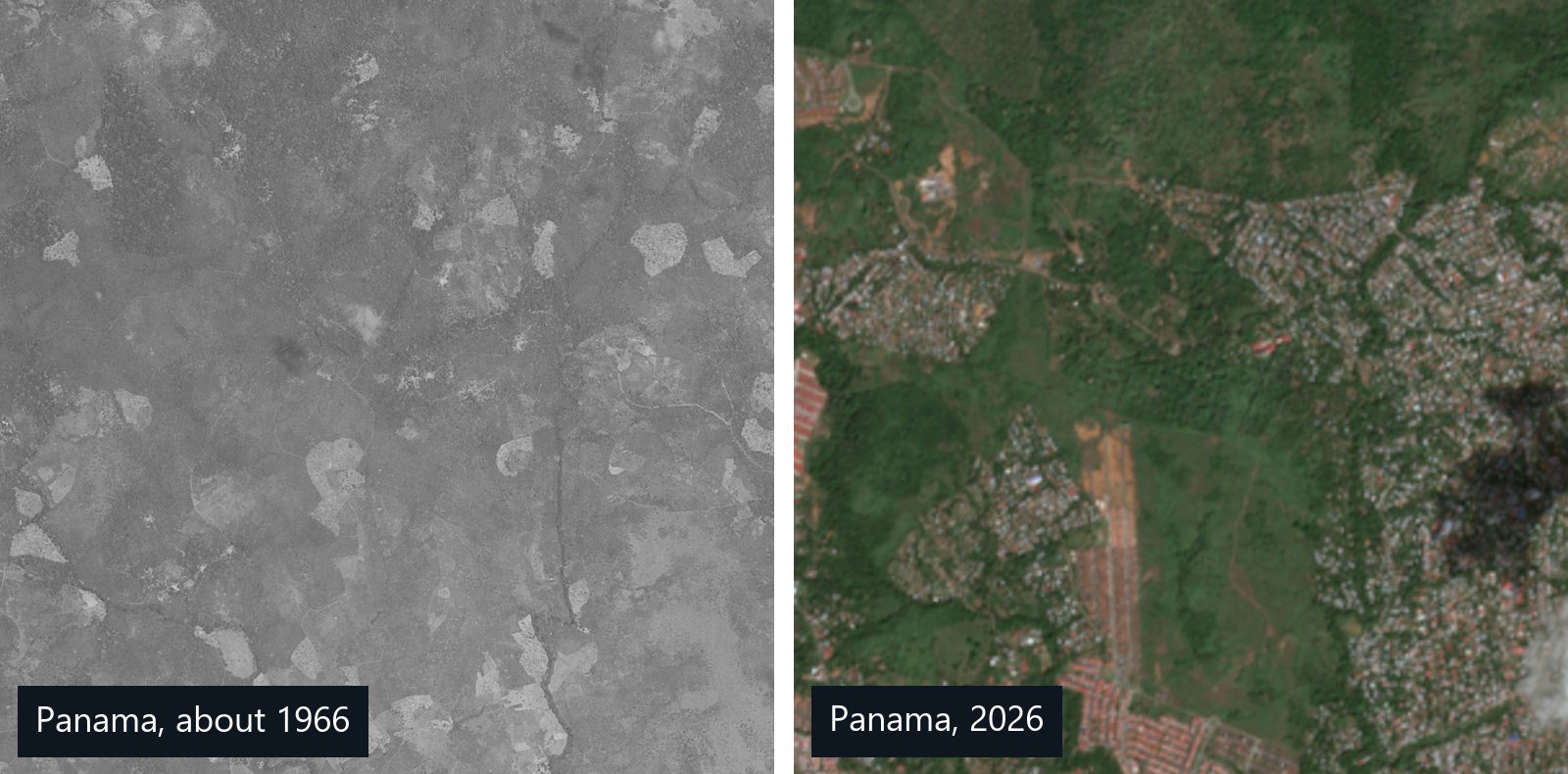
Forest with small clearings in Panama around 1966, and the same area in 2026 with suburbs replacing much of it
02 / DEFORESTATION

Prove what was forest, and when it changed.

Consistent forest and non-forest maps across decades quantify clearing, degradation and regrowth. They also give you the historical baseline needed for EUDR and other supply-chain due diligence.

  • Forest cover baselines
  • Loss & regrowth in hectares
  • Cut-off-date evidence
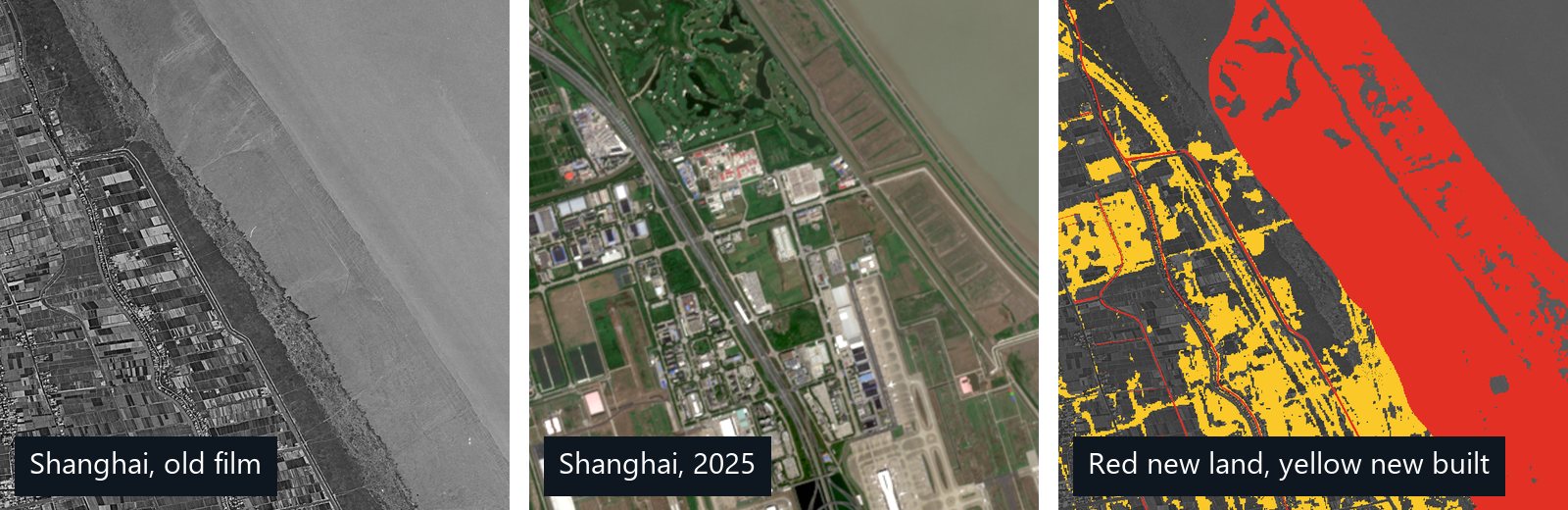
The Shanghai coast on old film and in 2025, with a change map showing new land in red and new built-up areas in yellow
03 / CHANGE DETECTION

Find exactly what changed, and how much.

Comparing any two dates reveals new roads, construction, mining, reservoirs and land clearing. Each change is classified by type and ranked by size.

  • Change maps & polygons
  • Change-type classification
  • Area & length statistics
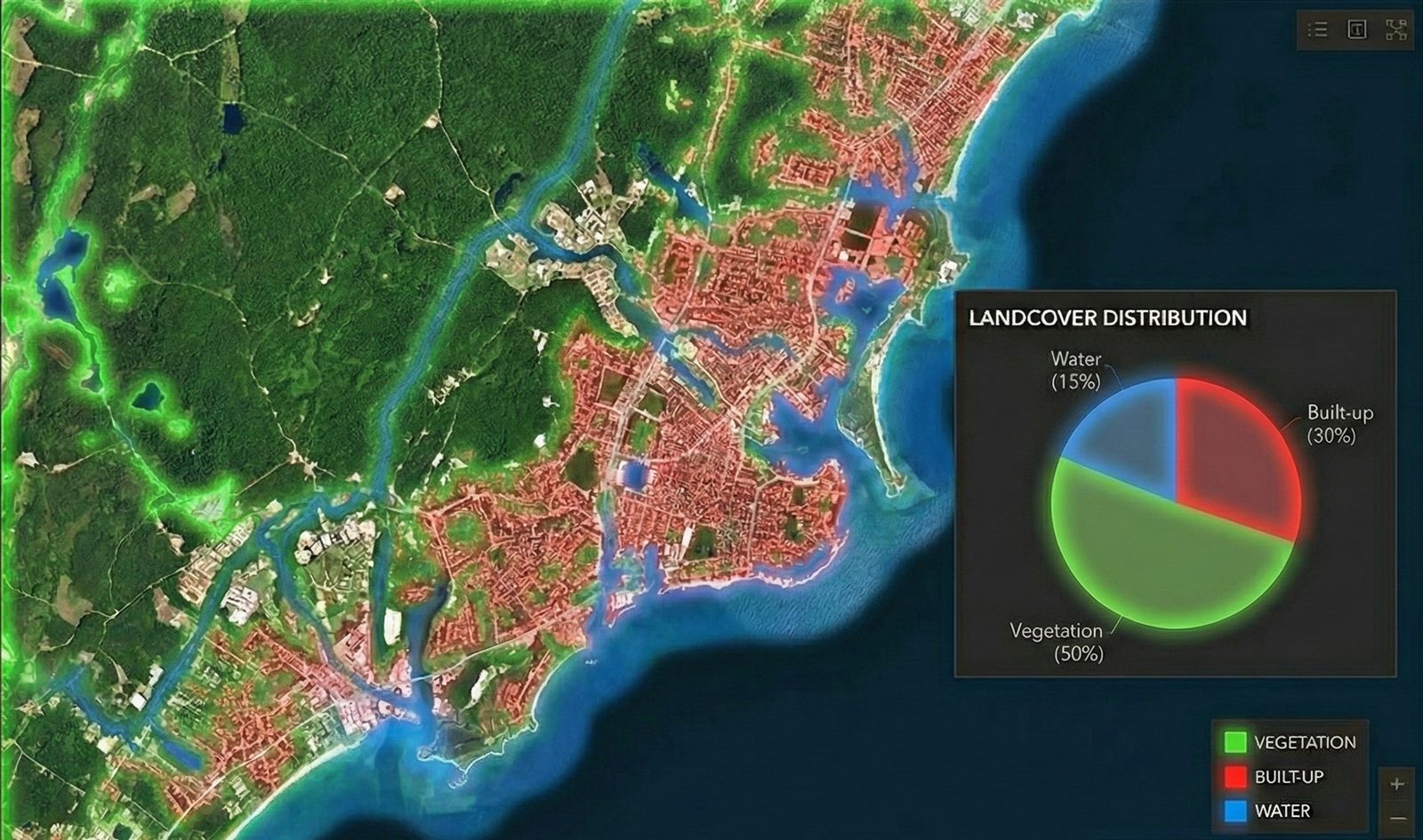
Coastal city classified into vegetation, built-up and water, with a land-cover distribution chart
04 / LAND-COVER MAPPING

One classification, consistent across every era.

We classify vegetation, built-up land, water and more, harmonised across sensors. That way a 1966 map and a 2025 map can be compared directly.

  • Classified rasters
  • Area distribution tables
  • Interactive dashboards

Solutions imagery: U.S. Geological Survey declassified archive and modified Copernicus Sentinel data 2025–2026. Shanghai change map: automated classification compared with © ESA WorldCover project 2021, contains modified Copernicus Sentinel data (2021) processed by the ESA WorldCover consortium.

Who it's for

When the question is “what was here before?”

Cities & planning

Reconstruct urban growth to plan housing, infrastructure and green space.

Supply chain & ESG

Historical forest baselines for EUDR, zero-deforestation commitments and sustainability claims.

Coasts & water

Shoreline retreat, land reclamation and mangrove and wetland change since the 1960s.

Property & due diligence

Site history for acquisitions, insurance, permitting and contamination risk.

Research & NGOs

Long-term environmental baselines for studies, monitoring programmes and impact reporting.

Heritage & archaeology

Early film shows landscapes and sites that later development has erased.

Start a project

Pick a place. We'll show you how it changed.

Send us an area of interest and a time period. We'll check archive coverage and suggest the right approach.

We'll reply to you by email.